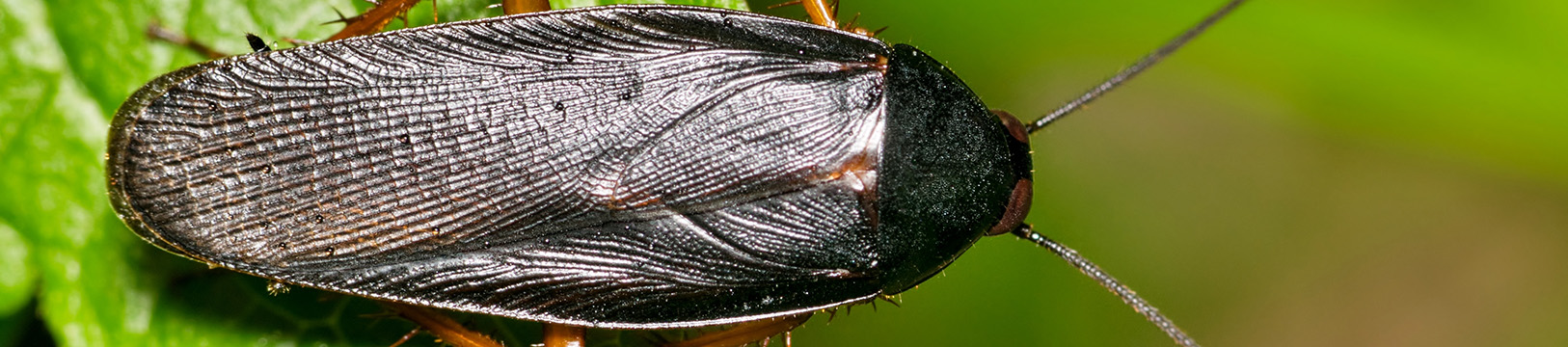
Smokybrown cockroaches are large, dark-colored roaches that typically live outdoors in warm, humid environments. They are commonly found around mature trees, leaf litter, wood piles, and other protected areas where moisture is available.
Although smokybrown cockroaches usually stay outside, they can move into attics, crawl spaces, garages, and other parts of a home that provide warmth, moisture, and shelter.
Smokybrown cockroaches are easy to distinguish from many other large roaches because their coloring is so uniform. Adults have a smooth, glossy appearance with no pale bands, stripes, or contrasting markings. Very young nymphs look noticeably different, with a distinct white band across the back and white markings near the tips of the antennae.
Quick ID
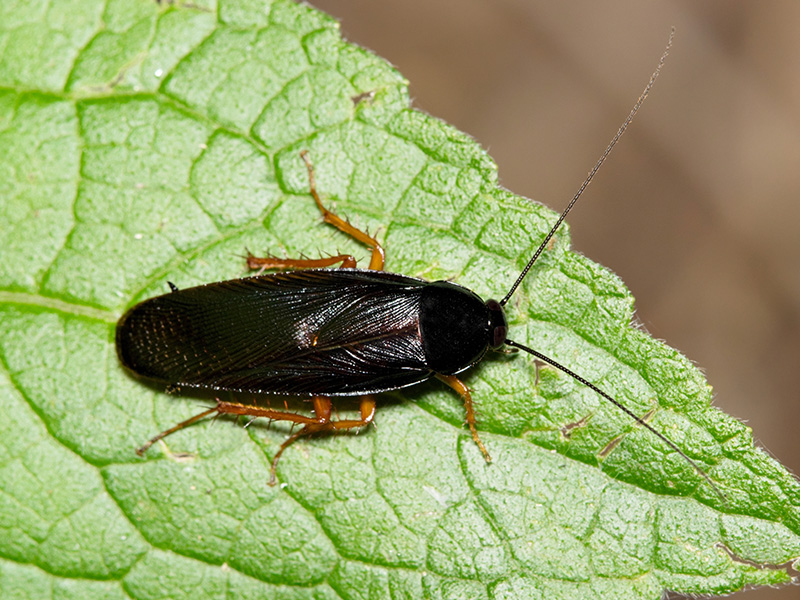
Smokybrown cockroach activity in North Metro Atlanta increases through spring and is highest from May through September. Activity typically tapers off in October and November as temperatures cool. Outdoor activity is very low from December through February, although smokybrowns can still survive in protected areas such as attics and crawl spaces.
Smokybrown and American cockroaches are both large roaches that are often called “palmetto bugs,” so it is easy to confuse the two.
One of the easiest differences to spot is the coloring behind the head. Smokybrown cockroaches are uniformly dark from head to abdomen. American cockroaches are more reddish-brown and have a noticeable pale yellowish marking behind the head.
Their overall appearance is also different. Smokybrowns have a darker, more uniformly colored and glossy body, while American cockroaches have more contrast between their reddish-brown bodies and lighter markings.
Smokybrown cockroaches depend on warm, humid conditions and prefer protected places where they are less likely to dry out.
Mature hardwood trees provide especially good habitat. Smokybrowns may live in tree holes and beneath loose bark, as well as in leaf litter, wood piles, sheds, and other outdoor hiding places.
They can also settle surprisingly close to the house. Gutters filled with leaves, damp crawl spaces, humid attics, wall voids, and areas behind fascia boards can provide the moisture and shelter they need.
Smokybrown cockroaches feed on decaying plant material and other organic matter, which helps explain why they do well around leaf litter, tree debris, wood piles, and similar outdoor areas. They may also feed on garbage, pet food, and other available food sources around homes.
Smokybrown cockroaches normally originate outdoors, so finding a single adult inside does not necessarily mean there is a large indoor infestation. One may have entered through a door, vent, roofline gap, garage, or another opening in the structure.
Exterior lights can also bring smokybrowns closer to the house after dark. Once they are around porches, doors, eaves, and rooflines, nearby openings can give them a way inside.
Repeated sightings are more significant, particularly when cockroaches are consistently showing up in an attic, crawl space, garage, or another warm, humid part of the structure. If those areas provide the right conditions, smokybrown cockroaches can survive there rather than simply passing through.
Very young nymphs can be an even stronger clue. Newly hatched smokybrown cockroaches do not travel far, so finding small nymphs indoors may indicate that an egg case hatched somewhere nearby.
Like other cockroaches, smokybrowns can travel through decaying organic matter, garbage, and other unsanitary areas before reaching household surfaces. Their droppings and shed body parts can also contribute to indoor allergens, which is another reason persistent indoor activity should be addressed.
Because smokybrown cockroaches usually come from outside, prevention should focus on reducing the moisture, hiding places, and access points around the house.
Homeowners can:
These steps will not eliminate every outdoor smokybrown cockroach, especially around wooded properties, but they can make the area immediately around the home less favorable to them.
If smokybrown cockroaches are regularly showing up around or inside your home, got bugs? Termite & Pest Solutions can help.
Our local team has been solving cockroach problems throughout North Atlanta since 2006. Smokybrown cockroaches are covered under our ongoing home pest control plans, which help protect homes from cockroaches and other common household pests.
Contact got bugs? today to request a free quote.
Yes. Adult smokybrown cockroaches are strong fliers, and both males and females have fully developed wings. They are especially likely to fly on warm, humid nights and are attracted to exterior lights, which can bring them close to doors, windows, porches, and rooflines. Young smokybrown cockroaches do not fly because their wings have not yet developed.
Female smokybrown cockroaches produce egg cases and leave them in protected hiding places, often attaching them to a surface. Outdoors, egg cases may be tucked into sheltered organic material and other protected harborages. Around homes, attics, wall voids, and similar hidden spaces can provide suitable places for egg cases.
Smokybrown cockroaches are not aggressive toward people, and biting is not typical behavior. Unlike mosquitoes and bed bugs, they do not seek out people for a blood meal. The greater concern indoors is potential contamination and the allergens associated with cockroach droppings and shed body parts.
Get In Touch
If you've got bugs or rodents infesting your home or yard, we can banish them for good! We are local pest control pros servicing North Metro Atlanta and are proud to offer quality treatments that deliver results.


